Riba Foods announces the announces the acquisition of Texas Brand Products.
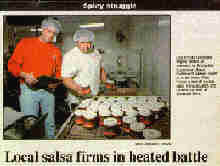
Houston Chronicle discusses the spicy struggle in Houston and its salsa manufacturer's.
Houston Metropoltan Magazine suggests ARRIBA! Autentica Fire-Roasted Red Salsa as a Holiday Gift Hit.
Riba Foods
Acquisition of Texas Brand Products
Effective August 18">
Riba Foods announces the announces the acquisition of Texas Brand Products.
Houston Chronicle discusses the spicy struggle in Houston and its salsa manufacturer's.
Houston Metropoltan Magazine suggests ARRIBA! Autentica Fire-Roasted Red Salsa as a Holiday Gift Hit.
Riba Foods
Acquisition of Texas Brand Products
Effective August 18, 1997, Riba Foods led by Miguel A. Barrios, President and CEO acquired Texas Brand Products, a Texas Company, and all the rights and recipes to the four products distributed under the Texas Brand Products name. Riba Foods plans to expand the current product line over the next three years to include at least 15 different items. Riba Foods due to trademark conflicts has renamed the product line to "Texas Pepper Works". The four products are as follows: Crispy Candied Pickles, Crispy Sweet Pepper Rings, Sweet Nacho Jalapenos and Jalapeno Mustard.
Richard Wall, National Sales Manager, sees the line as being an opportunity for Riba Foods to unveil some recipes which have been developed over the years but yet to have a home in a specific product line. The line is earmarked to compete in the gourmet and gift market arenas. Currently, the product is available in Houston and surrounding areas via Albertson’s, Kroger, Rice Epicurean, Randall’s and other grocery stores.
The planned expansion of this product line will commence around the Spring of 1999.
For further information on the product line click here.
Local salsa firms in heated battle
Trio in Houston battle for space on market shelves
Westpark Drive could be renamed Salsa Row.
The busy thoroughfare has become the battleground for Houston-area salsa manufacturers fighting in the salsa wars.
Fighting the battle for several years now have been Riba Foods and Henry's Dream, which both stir up their salsa brands in their Westpark offices near Gessner.
This year, another player joined the fiery competition.
Josefina's Mexican Salsa opened in March and is cooked and packed at the Los Tios Mexican Restaurants facility on Westpark, which makes salsa for eight local and state companies, including its own brand.
Until recently, Josefina's salsa was prepared at Henry's Dream, but the owners of the two companies had a falling out.
Switching packers is a common practice in the salsa wars, where each maker is out to find the lowest price.
"We basically do musical chairs," said Patricia Wright, financial director for Henry's Dream, which makes Tejano Salsa.
Stiff competition
With more than 900 blends and varieties of salsas and picante sauces sold in Texas alone, competition is stiff to say the least.
U.S. salsa sales for the year ending Nov. 9 totaled $766 million, according to Information Resources, a Chicago-based marketing research company.
Campbell Soup's Pace and Tostitos' Mexican Sauce & Marinades led the list, with $197.7 million and $181.7 million in sales, respectively.
The other major player is Pillsbury's Old El Paso Mexican Sauce & Marinades.
"They're the Coca-Colas of this business. They're the big guys," says Richard Wall, sales manager for Riba Foods, which makes Arriba Mexican Salsas and Dips.
Every salsa maker wants to compete with Pace, fighting for space on store shelves next to the salsa kingpins.
They all know how tough the competition is, with only an estimated one out of every four salsa companies surviving more than two years.
But the local salsa makers expect to win over customers with their traditional Mexican salsa, unlike the popular brands offered today that they describe as "spicy ketchup".
Salsa is something they have grown up eating-whether it be a recipe handed down for generations or a blend they created on their own - and each of these manufacturers considers its brand the best.
Now they just have to convince consumers and grocery store buyers of that.
Something to fall back on
Despite the competition, local salsa makers are realistic about their place in this risky market.
Although hopeful that their salsas will outpace national brands, each of these three salsa makers has something to fall back on if the business fails.
Henry Riojas, owner of Tejano Salsa, has kept his night job at Xerox as a computer technician and will not receive a paycheck from his company until he begins to see a profit, which he projects will be next year.
He reinvests most of the salsa sales money back into buying new equipment for the company, based in the two-bedroom home he grew up in on Westpark.
"We didn't go out and build this state-of-the-art facility and wait until the business comes," Wright said.
Miguel Barrios Jr., owner of Riba Foods, is a certified public accountant and has a marketing degree. When he started his business 10 years ago, he knew he could always become an accountant if the salsa business was not successful.
Barrios, then 24, received an $80,000 loan from the Small Business Association and went to work with Rico Valencia, the owner of Cyclone Anaya's Mexican restaurant, to develop a salsa recipe. Cyclone Anaya's which has since closed its Houston location, was built by Barrios' father.
"I leased the restaurant at night from 11 to 7. I was determined to do this," Barrios said, as he munched on chips and Arriba salsas while discussing the salsa business with Wall and his father, Miguel Barrios Sr., also vice president of operations of the company. "I was young enough, that if I messed up, with a CPA I could start all over."
Diana Ramos, Hortencia and Jose Saldaña, the siblings who own Josefina's Mexican Salsa, continue to operate their tire business.
"The salsa is going to exceed the sales of the tires," said Ramos, who cooked salsa for several years before deciding to bottle it, complete with a label that depicts their grandmother's home in Monterrey and tells the history of her recipe.
A shot at the shelf
Before a salsa can compete with bigger makers, the smaller companies must prove that the family recipe they've grown to live will be loved by others as well.
"I think there's a lot of family recipes that are out there that were handed down," said Texas A&M University Extension Food Technologies Al Wagner. "I do get a number of Hispanics that have a recipe handed down for generations, but a big bunch of them are us gringos that (the recipe) was handed down to through the family."
The one person who can make those salsa dreams come true and get the product on the shelves is the buyer for the grocery store.
"Some people are so close to the fire and they think their product is so dang good and it may be good in the kitchen, said Scott Silverman, Rice Epicurean vice president of specialty foods.
Silverman, who also is the grocery chains buyer, is approached by 50 salsa makers every year and chooses which products to put on his shelves, basing his selection not only on taste and demand, but its uniqueness to the market.
"For every one that we carry, there's probably 50 out there," he said. "We can't just carry everybody. Usually every year, I throw out about 20 percent of my salsas and add 20 percent."
If the salsa moves well and if he thinks there is a demand, Silverman will continue to carry the brand.
The veteran in Houston's salsa scene is the Arriba line. The company also packs salsas, Mexican sauces, pickles and jalapeños for other companies, earning nearly $2 million of sales annually in that business and more than $1 million in sales from its private label of fire-roasted Mexican salsas, dips and sauces.
"Generally speaking, Arriba is a survivor," said Silverman, who has stocked his shelves with several of the company's products since it started making salsa. "I'm fairly proud of them being a local company."
Finding a niche
As a CPA, Barrios conducted a study for salsa companies, finding that it was expected to become an increasingly lucrative business, generating more than $1 billion in sales.
That growth has been attributed to the growing number of Hispanics in the United States, but most salsa makers say that Hispanics are a small market for them, as most prefer to make their own salsa.
Barrios, whose father is from Mexico City, was accustomed to homemade salsa, but had never made salsa himself.
But that didn't stop him from enlisting in the salsa wars that at that time were heating up even more so than now. Barrios wanted his own business and his father's friendship with the restaurant expert, Valencia, seemed like a perfect opportunity to start up a salsa company.
Teaming up with Valencia, his father and former Cyclone Anaya's chef, Barrios developed a line of fire-roasted salsas and dips similar to the cooking technique used in Mexican restaurants.
"That's our claim to fame - we fire roast the produce," said Wall, walking through the company's kitchen where fresh garlic, tomatoes, onions and chile peppers roasted over the open flames.
A unique feature of the salsa is the black specs that come from fire-roasting the vegetables. Many first-time consumers of the product are confused about what they are. One consumer even wrapped up all the specks in aluminum foil and sent them to the company, believing they were bugs.
"We feel like the black specks add voice, appeal and flavor to the product," Wall said.
Now, the company uses the fire-roasting method to make salsa and other tomato and pepper-based products for more than a dozen condiment companies.
Henry's ream also makes salsas and sauces for other companies. However, most of owner Henry Riojas' kitchen staff, which includes his mother, are kept busy making his Tejano Salsa brand of salsas, sauces and mixes.
By starting his own company five years ago, Riojas hoped to combine his two loves-cooking and fishing. For several years he had planned to buy a fishing pier in Galveston and open a restaurant on it.
"That was the whole idea of salsa, was to raise money for the fishing pier. That's why it's called Henry's Dream," Riojas said.
But he later realize his dream had changed when the pier was sold.
"My real dream was to have a business," said the cherry Riojas.
His dream also is to work full-time on his salsa business.
Las year, the company saw $35,000 in sales and hopes to see a profit next year.
When he first started his salsa-canning business, Riojas did not know how to run a business or can salsa. So he spent his vacation in canning school and relied on help from experts, including Wagner.
Shortly after receiving a patent number for his salsa's name, Tejano Salsa, another company began to use the same name for their product.
"It was actually impeding our sales," said Riojas. "All our advertising was actually helping them sell their bad salsa."
The company has since stopped making the salsa, but Riojas does not know for how long he is afraid that he does not have the funds to pay for an attorney if the company begins selling its brand of Tejano Salsa again.
Riojas is more concerned about expanding his business, developing new products and going into the delivery business for other food product manufacturers. With his line of taco, fish and rice sauces and mild-flavored salsas, Riojas is trying to promote salsa as more than just a dip for chips, but a seasoning that can be used while cooking a variety of dishes.
He also is trying to manufacture salsa for more companies. One of the companies Henry's Dream once packed for was Josefina's salsa.
A disagreement over prices led Josefina's owners to take their packing business to Los Tios.
The three owners of Josefina's Mexican Salsa hope to begin producing the salsa themselves out of a downtown restaurant scheduled to open in February.
Nine months ago, the three sibling owners of Josefina Mexican Salsa began selling the salsa that is based on their grandmother's recipe. Since the, they have sold 54,000 jars, earning $30,000 in sales.
But for the Saldañas, that is a small amount compared with the $1 million in sales they are accustomed to in their tire business.
The entrepreneurs know how much competition there is in the salsa business, but after running a tire and foreign car body shop for eight years selling a recipe they have loved all their lives doesn't sound so difficult.

Norteña Gourmet Sauces Introduction
Arriba! New Exotic Hot Pepper Sauces
Fort Worth Star
Telegram Article 
Texas brands come out on top when chips are down
In the Star-Telegram's taste test of 45 salsas, pico de gallo and picante sauces, not one of the top winners is from NEW YORK CITY. In fact, four of the top five brands ranked in our test are produced in Texas.
Our panel of five tasters included two Texans, two Yankees and a heat lover from Louisiana. All the hot sauces were tasted "blind," unlabeled in identical bowls. Panelists judged Texas' favorite snack dip on color, consistency, flavor and texture.
In the interest of maintaining some trace of the tasters' taste buds, the "mild" version of each sauce was served, if the product was available in different heat ranges. The Yankees were relived, the Texans muttered "big hat, no cattle" and the Louisianan threatened to whip out a bottle of Tabasco sauce.
Shopping at area supermarkets, we found 45 sauces to test. That number alone attests to the popularity of this Mexican accent on Southwestern cuisine.
....The third top finisher, Arriba!, is a thick salsa made in Houston. Panelists like the roasted peppers mixed with the tomatoes and spices....
Rosarita, a Hunt-Wesson brand, is produced in Mesa, Ariz. That ain't Texas, but it ain't New York either. Tasters like Rosarita's chunky texture.
Territorial House Green Chile Salsa, despite its New Mexican name, is bottled by the Pace folks in San Antonio. The heavy tomato flavor ranked high.
Skipping to the bottom of the list, we discover Old Fashioned Cheese Squeeze Salsa, a concept whose time, our panelists concurred, has not come. The Wisconsin product was knocked for looking like ketchup and tasting sour.
El Rio Taco-Nacho Chip Dip with Chilies from Ohio tasted "blah" and had "no texture."
El Paco Chunky Picante Sauce out of Dallas was the Lone Star contribution to the bottom five sauces. "Strong tomato soup flavor," agreed panelists.
Kroger won't say where it produces its Picante Sauce. It says the information is proprietary; our panelists say the Cincinnati firm's dip "tastes like re water and looks like barbecue sauce."
Pulling up the rear in 45th place is Embasa Mild Jalapeño red Salsa, a sauce from Mexico, the home of salsa. "This taste does not occur in nature sums up the low total.
San Francisco
Chronicle ranks the ARRIBA! 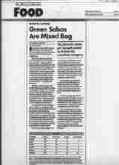
Green Salsas Are Mixed Bag
Salsa has reportedly passed ketchup as America's favorite condiment, and the selection of ready-made salsas is staggering.
The taste panel explored one subcategory of the group - green salsas - dipping into eight brands purchased at local supermarkets. The results were mixed, to say the least: The favorite salsa, a newcomer on the local scene, got enough points to fit into the excellent category, but four of the eight products sampled got ratings of 25 points or less - a deplorable showing.
The star of the group was Arriba! (16 ounces, $3.29), which we found at Andronico's. It was called fresh tasting, pleasantly hot and chunky. There were comments on a distinct roasted tomatillo flavor, and one panelist simply wrote, "great taste." All five tasters would by it.
A respectable second-place vote went to an old-timer. Old El Paso (16-ounces, $2.29 to $2.43) was given good marks on chunky texture and lively color. Most tasters were pleased by its moderately spicy flavor, though one commented that the aftertaste seemed thin. Three of the five judges would buy it and the remaining two said maybe.
There was a big rating drop to third-placed Herdez (seven ounces, 93 cents to 99 cents), which did not match the robust texture of the two front-runners, being called mushy and a bit watery. The taste was variously described as salty or vinegary and "not real great." Two panelists might buy it.
Yet another precipitous drop led to fourth-place Las Guitarras (16 ounces, $3.49), which did gain favorable comments on its appealing deep green color and chunky texture.
Unfortunately, the flavor id not match the looks and was called strange, garlicky, sweet, artificial and resembling canned spinach. None of the tasters would purchase this brand.
The remaining four salsa, in descending order of points, were Parrot Brand, Embasa, La Victoria and La Tortilla Factory. Other products from several of these companies did well in past taste tests, but the panel's recommendation on their green salsas is "back to the test kitchen."